 Chapter 1 of 3
Why the Sky is Blue & Sunsets Red
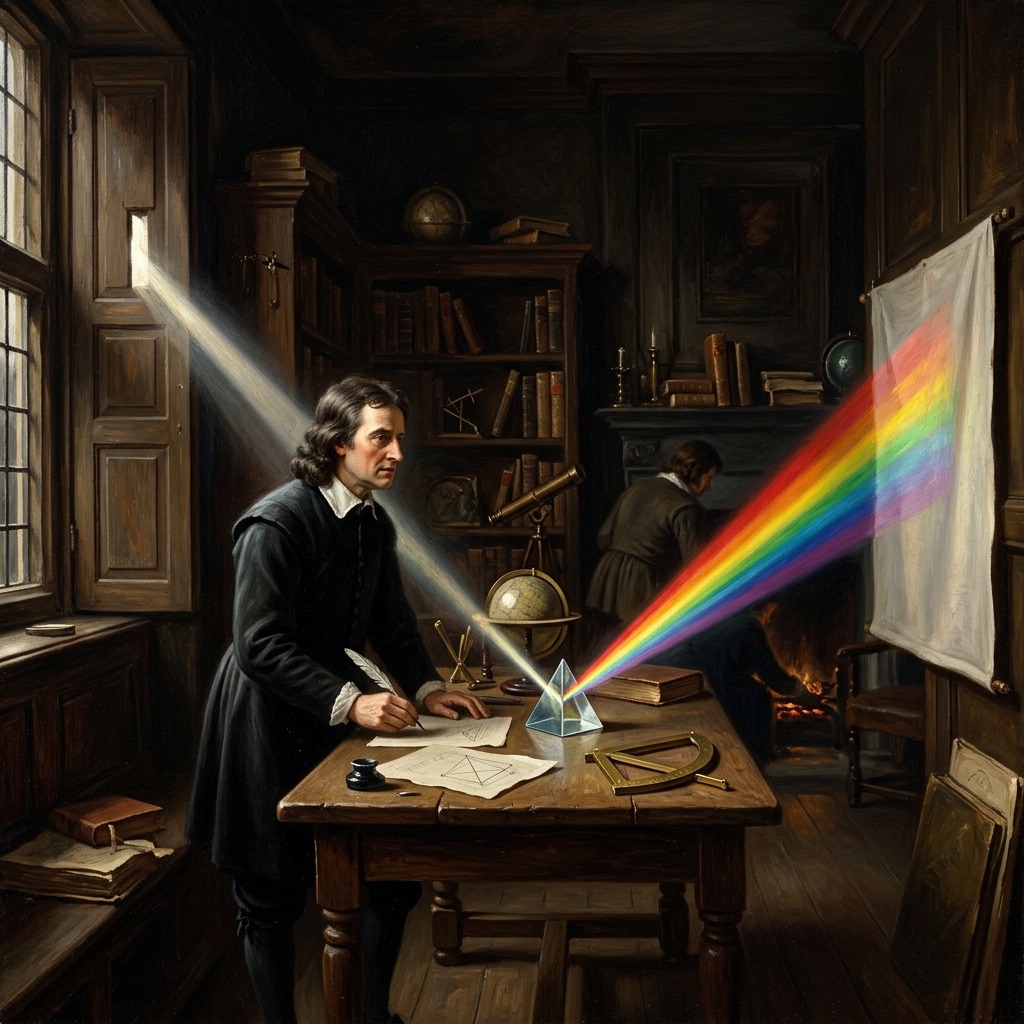
Sunlight looks white, but it isn't one colour. In 1666, a young Isaac Newton passed a beam of sunlight through a glass and watched it fan out into a rainbow. Then he used a second to squeeze those colours back into white light. White, he showed, is a of every colour at once. Light travels as a wave, and its colour depends on its : the distance from one wave to the next. These distances are tiny. Red light's waves are about 700 billionths of a metre long, and blue light's about 450, less than a hundredth of the width of a hair. Red is the long, lazy wave; blue and violet are the short, tight ones. When sunlight enters our , it travels through an ocean of air molecules, mostly nitrogen and oxygen. Each one is thousands of times smaller than a single of light. What happens when light meets something that small depends on its colour, and that difference is what paints the sky.
Think
Newton used a second prism to turn the rainbow back into white light. Why was that second step so important?
Try it
On a sunny day, stand with your back to the sun and spray a fine mist from a garden hose or a spray bottle. Each droplet acts like a tiny prism, and you'll see your own rainbow.